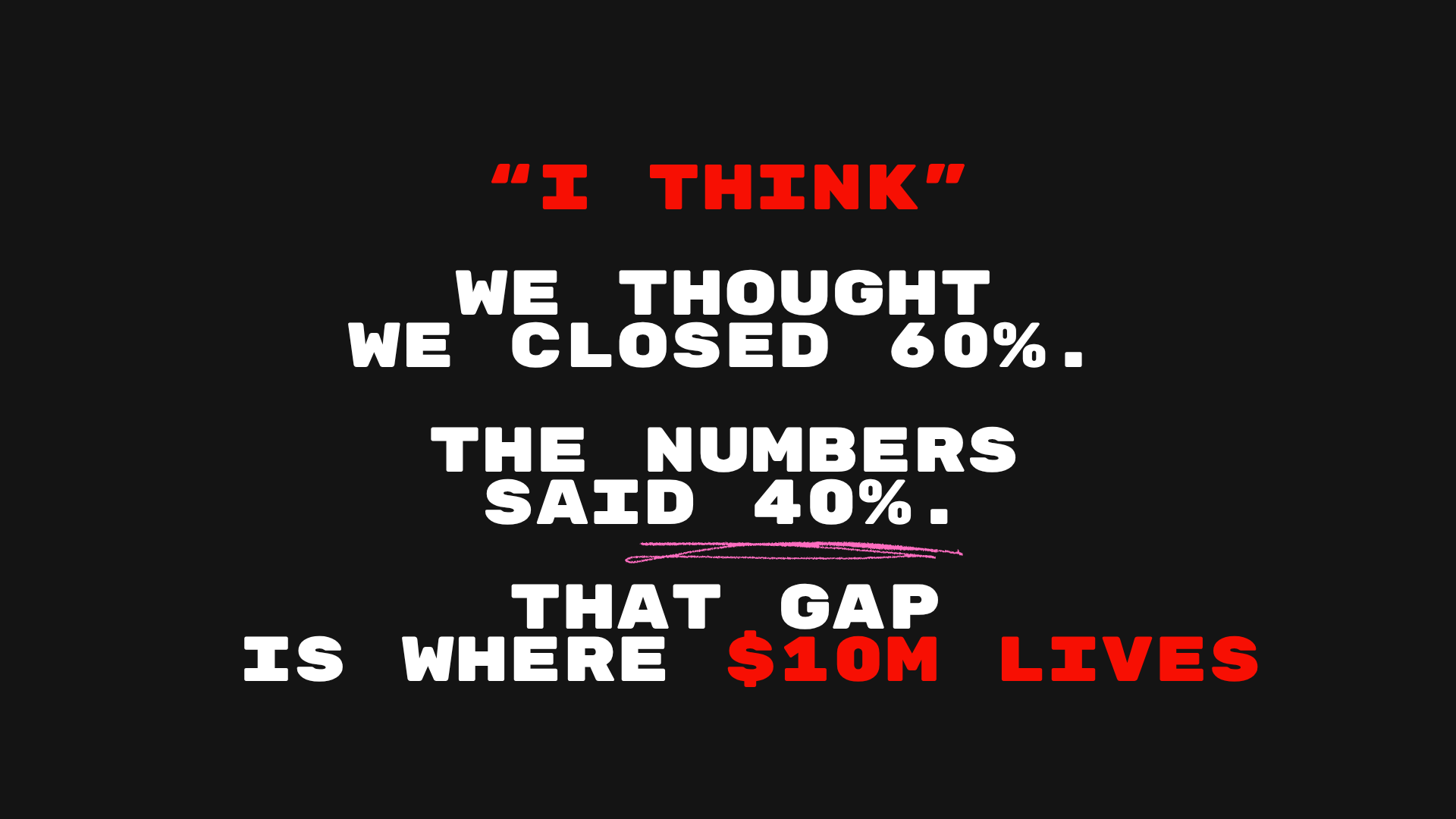
They Thought They Closed 60%. The Numbers Said 40%. That 20% Gap Is Where $10M Lives.
In service businesses, 'busy' is not proof of scale - it's often proof the foundation is broken. Here's the foundation rebuild and 3 moves you can implement this week.
In service businesses, the easiest lie to believe is this:
The diary is full.
The team is flat out.
Money is coming in.
So you assume the business is healthy.
But "busy" is not proof of scale.
It is often proof the foundation is broken.
I'm in the middle of an acquisition right now - out-of-ground construction: asbestos, demolition, excavation. Jobs range from same-day callouts to 2–3 day work to multi-week projects.
The goal is simple: move the company from $3M to $10M in 18 months.
On paper, it looked solid.
Then we did the first thing most founders avoid:
We stopped guessing and pulled the actual numbers.
Here was the first punch in the mouth:
They believed the close rate was 60%.
At best, it was 40%.
Not because anyone lied.
Because the business was running on "we think."
And if you're trying to scale, "we think" becomes an invisible tax that compounds every month.
This article is the foundation rebuild we're running right now - and the 3 moves you can implement this week to get immediate lift without hiring a small army.
The Quiet Killer: "We Think"
From the outside, it looked scale-ready.
From the inside, it sounded like this:
We think leads are strong.
We think sales are converting.
We think the team is productive.
We think we're making money on this job type.
Think. Think. Think.
No clean definitions.
No single source of truth.
No consistent follow-up rhythm.
No visibility from lead to cash.
Guesswork is survivable when you're starting.
Guesswork is lethal when you're scaling.
Because scaling multiplies everything:
Wins.
Costs.
Mistakes.
Leaks.
And leaks you can't see will bankrupt you at volume.
What Actually Breaks When You Try to Scale (In Trades)
Most founders blame the ceiling on the market or competitors.
In trades, the ceiling is usually inside the business:
1) Quotes leak quietly
Quotes go out and die in silence.
Not because your work is bad.
Because your follow-up system is weak or inconsistent.
2) Capacity becomes chaos
You "feel" busy, so you keep selling.
But you can't clearly see:
- What capacity you really have next week.
- Where drive-time is killing productivity.
- Which job types clog the diary but produce no margin.
- Which crews are carrying the profit and which are carrying the problems.
3) Cash gets stuck in admin friction
Invoicing delays.
Variations not captured.
Scope unclear.
Materials/consumables inconsistently accounted for.
Customers chasing updates.
The business can look profitable and still be structurally weak because cash timing and process errors hide inside revenue.
The Foundation Rebuild We Started With (Not Growth)
We didn't start with "more marketing."
We started with foundations, in this order:
People. Systems. Numbers.
Because growth on a messy foundation isn't growth.
It's stress.
Step 1: People (outputs, not activity)
We sat down with the team and asked:
- What are you actually doing every day?
- What's the output of that work?
- What happens next when you finish?
- Where does the information go?
"Busy" isn't an output.
A booked job, a sent quote, a completed follow-up, an issued invoice - those are outputs.
Step 2: Systems (one way, not ten workarounds)
Then we looked at how work moved through the business:
Phones. Enquiries. Site visits. Quotes. Follow-ups. Scheduling. Delivery. Variations. Invoicing. Collections.
We found the usual: spreadsheets on spreadsheets. Workarounds on workarounds.
Good people trying to hold together a system that was never built to scale.
At $1M, heroics look like "culture."
At $5M, heroics become a tax.
At $10M, heroics break the business.
Step 3: Numbers (truth, not vibes)
Then we went to the place most founders avoid until it hurts:
True margins. True costs. True conversion rates. True cash timing.
If you don't know your true cost base, you don't have a business.
You have a gamble.
Clean Data or Don't Bother Scaling
This part is not sexy.
It is the difference between a company that scales and a company that stays busy forever.
We tightened finance and reporting around questions like:
- Are the financials reconciled properly?
- Is revenue recognised correctly?
- Can we trust the numbers we're making decisions on?
- Are consumables and materials consistently coded to jobs?
- How long after job completion does the invoice go out?
- How long after invoice does cash land?
Every "big move" without clean data is just a dressed-up guess.
And guesses don't scale.
The 3 Moves You Can Implement This Week (Action, Not Motivation)
If you want tangible, here it is. Run these three and you'll immediately see where the business is bleeding.
1) Build a "Lead-to-Cash Scoreboard" (10 numbers, weekly)
Pick 10. No more.
Minimum numbers that matter in a trade/services business:
- Leads received (by source)
- Calls answered vs missed
- Speed-to-lead (time to call back)
- Site visits booked
- Quotes sent
- Follow-ups completed (24h / 72h / 7d)
- Jobs won
- Jobs lost + reason code (price / timing / trust / couldn't reach / other)
- Average job value
- Days from job completion → invoice sent → cash received
If you can't see these weekly, you're driving at night without headlights.
2) Run a "Margin Truth" Audit (top 5 job types, 2 hours)
List your top 5 job types (e.g. callouts, 2–3 day jobs, multi-week projects).
For each, write:
Price
Minus labour time (even estimated)
Minus materials/consumables
Minus disposal/plant/third-party costs
Equals rough gross margin
You will find at least one "popular" job type that is:
- Underpriced.
- Poorly scoped.
- Eating time.
- Quietly loss-making.
Then you make the decision most founders avoid:
Raise the price.
Systemise delivery.
Or stop selling it.
3) Install a Follow-Up SLA (and stop being polite about it)
If you want a real close rate, you need a real follow-up machine.
Set a standard:
- Every quote gets follow-up at: 24 hours, 72 hours, 7 days.
- Every follow-up is logged.
- No quote is "dead" without a reason code.
Use one direct line that forces clarity:
"Just checking - are we parked because of price, timing, or did something not feel right?"
That single question will recover jobs you are currently losing to silence.
The Point Most People Won't Cross
This is the line where businesses split.
One path:
"We've always done it this way."
Ego. Habits. Comfort.
The other path:
Data. Discipline. Repeatability.
It's not exciting.
It's what builds empires.
The Play We're Running to Go From $3M to $10M
We are not chasing growth for the sake of it.
We're rebuilding the foundation so growth actually holds:
- Clean data.
- Clear metrics.
- Aligned systems.
- Accountable teams.
- True profitability by job type.
- A weekly decision rhythm instead of reactive chaos.
Once that's in place, scaling stops being chaotic.
It becomes predictable.
And predictable is profitable.
If you're running the business on gut feel, you're not leading.
You're hoping.
Hope is not a strategy.
Get clear on the numbers.
Get ruthless on the systems.
Get honest about the gaps.
That's how you build something that actually scales.
About Kristina Katsanevas
Technology leader, executive coach, and professional speaker helping organizations and individuals navigate the intersection of AI, leadership, and career growth.